

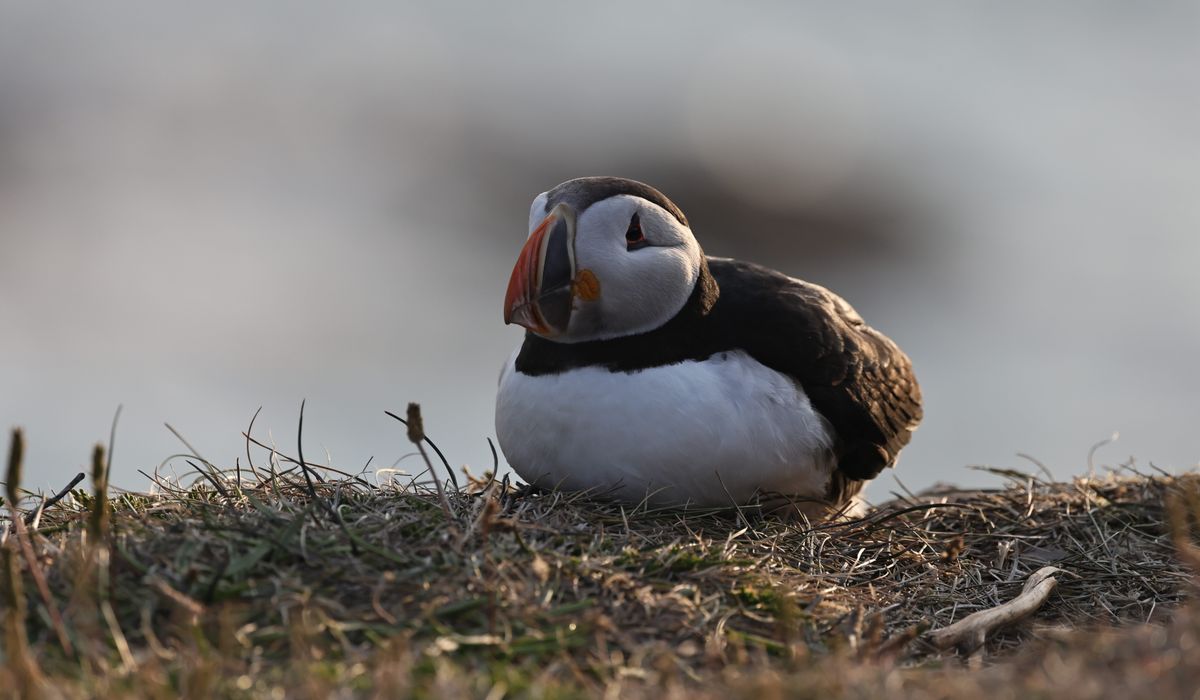
Why Timing Matters More Than Gear
Between April and July, the cliffs and islands around the UK become the busiest neighbourhoods in the country. Guillemots crowd onto ledges barely wide enough for their feet, puffins shuttle sand eels into burrows, and gannets stack up shoulder to shoulder on sea stacks. It is a photographer’s dream, and it is also the most vulnerable few weeks of the year for the birds themselves.
A disturbed colony does not simply rearrange itself and carry on. When adults flush from a ledge, eggs and small chicks are left exposed to herring gulls and skuas, who need only a few minutes. On burrow-nesting islands, an adult scared away from its entrance may abandon the site altogether, and a puffling that never gets fed does not survive. The birds have travelled thousands of miles to raise one chick. Our job, as photographers, is to be the least interesting thing on the cliff.
That means knowing your species. Puffins and razorbills peak from late April into July, with pufflings fledging mostly at night in July and early August. Guillemots and kittiwakes are on eggs from May. Terns arrive later and nest on flat ground, which makes them especially easy to walk into by accident. Plan your trip around the calendar, not just the tide table.
Long Lenses and the Art of Staying Back
Reach is your first line of defence. A 300mm lens on a crop-sensor body is a reasonable minimum, and 400mm or 500mm on full frame is genuinely useful. A 1.4x teleconverter costs far less than a new lens and buys you metres of respectful distance.
- Work the light, not the proximity. Early mornings and late afternoons give you low, warm light, longer exposures at sensible apertures, and calmer air. Heat haze off cliffs flattens detail by mid-morning in summer.
- Stop down slightly. f/6.3 to f/8 keeps a whole bird sharp when it is small in the frame. You can crop later.
- Use a beanbag or a tripod with spikes. Cliff-top wind is relentless and a heavy support lets you shoot at low ISO rather than chasing shutter speed.
- Protect the front element. Sea spray and guano are abrasive. A lens hood and a wipe-down cloth are essentials, not luxuries.
Barriers, Paths and Burrows Underfoot
Rope lines, low fences and roped-off viewpoints at seabird colonies are not decorative. They mark the edge of what the birds will tolerate, and in some cases they protect ground that looks solid and is not.
- Never step over a barrier for a better angle, however empty the ledge looks.
- Stay on established paths and durable ground. Tussock grass hides burrow entrances, and a boot through a puffin burrow can collapse a nest chamber with the chick inside.
- Sit or crouch only where it is clearly safe and permitted. Cliff edges crumble, and a slipped tripod is a worse outcome than a missed frame.
- Keep dogs on a short lead or leave them at home during breeding season.
- Give hauled-out seals a wide berth too. They are easily panicked into a stampede towards the water, which injures pups.
Drones, Distance and the Law
Drones and nesting seabirds are a poor combination. Many island reserves, nature reserves and National Trust coastal sites ban drone use outright during the breeding season, and some prohibit them year-round. Check before you pack, and treat a refusal as final.
Where flying is permitted, the Drone Code still applies: keep the aircraft in sight, well clear of people, and never fly over a colony. Under the Wildlife and Countryside Act 1981, it is an offence to intentionally or recklessly disturb a wild bird listed on Schedule 1 at, on or near an active nest — and many seabirds, including several tern species and storm petrels, are on that list.
As a working rule, keep at least 150 metres from any cliff face, stack, burrow field or raft of birds, and further if the colony is dense or the birds are already alert. Flying high and far is not a loophole: a distant dot of a drone can still trigger alarm behaviour in a colony that reads silhouettes for a living.
Reading the Signs of Stress
Birds tell you when you have crossed a line. Learn the early signals and you can back off before any real harm is done.
- Head bobbing, wing flicking and sharp alarm calls spreading outwards from your position.
- Adults taking off en masse or circling without landing.
- Gulls and skuas drifting in, drawn by the commotion — a clear sign the colony is unsettled.
- Chicks flattening against rock or scattering into vegetation.
The test is simple: if the birds change what they are doing because of you, you are too close. Withdraw slowly and steadily rather than turning and striding away, which causes more panic than a calm retreat. Then reconsider your position — a slightly longer lens, a different path, or a different time of day will usually solve it.
Fieldcraft for a Calm, Productive Day
The best seabird photography sessions are slow, quiet and slightly uncomfortable. Arrive before dawn, dress for wind and rain even in June, and expect to spend an hour waiting for one bird to turn its head into the light.
- Check the tide and the boat timetable. Some islands are cut off for hours, and being stranded is not romantic when you are soaked.
- Shoot through the middle of the day only if the weather is overcast, which gives soft, even light and reveals feather detail without harsh shadows.
- Carry out everything you carry in, including lens caps, battery wrappers and sandwich crusts, which attract gulls to a colony.
- Think before you share a location. A geo-tagged photograph of a sensitive nest site can send a crowd somewhere it should never go.
Photograph the birds you can see from where you are allowed to stand, and you will come home with better images than the person who crept ten metres closer and sent five hundred pairs of wings into the air. The colony will still be there next spring, and so, with any luck, will your best puffin shot.



John Doe
14 January, 2022Having no content in post should have adverse..
Chauffina Carr
10 April, 2022We use these tests all time! Killer stuff!
Jim Séchen
16 July, 2022Thanks for all the comments, everyone!